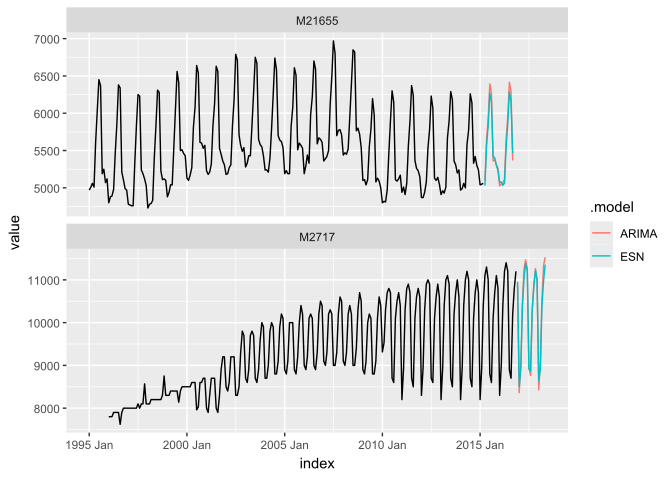




The echos package provides a comprehensive set of
functions and methods for modeling and forecasting
univariate time series using Echo State Networks
(ESNs). It offers two alternative approaches:
numeric vectors, allowing for
straightforward integration with existing R workflows.fable
framework based on tsibble,
enabling tidy time series forecasting and model evaluation. This
interface leverages the fabletools
package, providing a consistent and streamlined workflow for model
development, evaluation, and visualization.The package features a lightweight implementation that enables fast and automatic model training and forecasting using ESNs. You can quickly and easily build accurate ESN models without requiring extensive hyperparameter tuning or manual configuration.
echos implements Echo State Networks with a fixed
randomly initialized reservoir and a ridge-regression readout. The input
and reservoir weights are generated once and kept fixed, while only the
readout layer is estimated.
The main ESN hyperparameters are the reservoir size
(n_states), leakage rate (alpha), spectral
radius (rho), reservoir density (density),
input scaling (scale_inputs, scale_win,
scale_wres), and the ridge regularization range
(lambda). These parameters control the memory, stability,
complexity, and regularization of the model.
By default, train_esn() automatically determines the
number of differences, constructs the reservoir, evaluates candidate
ridge readout models, and selects the final readout using an information
criterion. For explicit grid-based tuning of alpha,
rho, and tau, use tune_esn().
You can install the stable version from CRAN:
install.packages("echos")You can install the development version from GitHub:
# install.packages("devtools")
devtools::install_github("ahaeusser/echos")library(echos)
# Forecast horizon
n_ahead <- 12 # forecast horizon
# Number of observations
n_obs <- length(AirPassengers)
# Number of observations for training
n_train <- n_obs - n_ahead
# Prepare train and test data
xtrain <- AirPassengers[(1:n_train)]
xtest <- AirPassengers[((n_train+1):n_obs)]
# Train and forecast ESN model
xmodel <- train_esn(y = xtrain)
xfcst <- forecast_esn(xmodel, n_ahead = n_ahead)
# Plot result
plot(xfcst, test = xtest)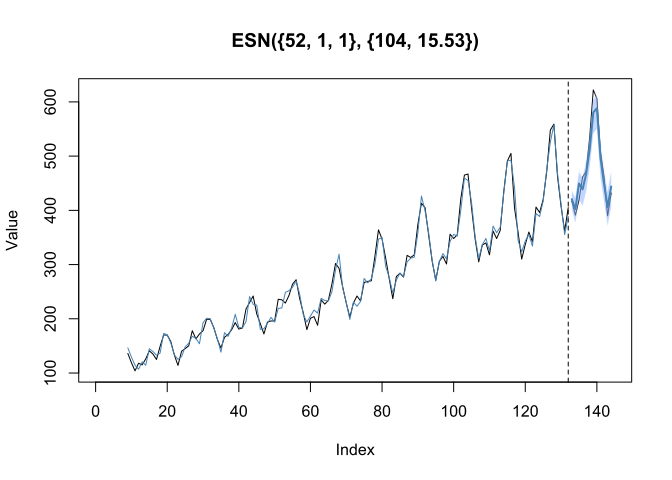
library(echos)
library(tidyverse)
library(tsibble)
library(fable)

# Prepare train data
train_frame <- m4_monthly_subset %>%
  filter(series %in% c("M21655", "M2717"))

# Train and forecast ESN model
train_frame %>%
  model(
    "ESN" = ESN(value),
    "ARIMA" = ARIMA(value)
    ) %>%
  forecast(h = 18) %>%
  autoplot(train_frame, level = NULL)